Robeytech
  • Home
    • Giveaways
    • Wallpapers
    • Affiliates
  • stepbystep
  • Builds
  • Budget Builds
  • Resources
    • How to install Windows
    • GPU Drivers
    • GPU Minimum PSU Requirements
  • Store
    • PC's For Sale
  • About Us
  • Admin
Search
Search
  • Home
    • Giveaways
    • Wallpapers
    • Affiliates
  • stepbystep
  • Builds
  • Budget Builds
  • Resources
    • How to install Windows
    • GPU Drivers
    • GPU Minimum PSU Requirements
  • Store
    • PC's For Sale
  • About Us
  • Admin

Lian Li O11 Dynamic EVO XL

10/1/2023

0 Comments

 
Picture

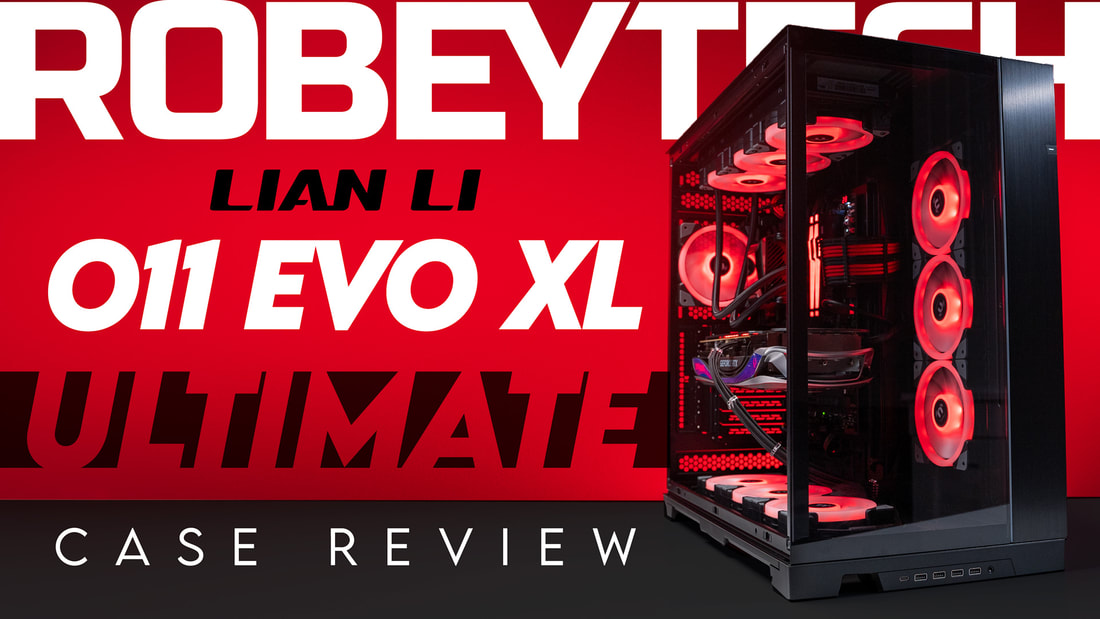
The Lian Li O11 Dynamic EVO XL provides a bigger canvas for showcase builds in a landscape of ever-growing PC parts.

It’s no secret that we love Lian Li’s O11 Dynamic Evo; it’s a great canvas for some really pretty builds, and it’s incredibly customizable. However, it has a HUGE problem: some of these modern PC components are just so thick! I’m talking triple C, heckin’ chonker THICCCK, and I’m not sure they are getting smaller any time soon.

But, if you like big builds and you cannot lie, Lian Li has introduced the O11 Dynamic EVO XL - a girthier version of their beloved case with extra space to accommodate the finest of PC components. There were a few design choices that left us a bit disappointed, but to their credit, Lian Li addressed one of them while we were still writing this review!

Introducing the O11 Dynamic EVO XL!

If you aren’t familiar with Lian Li’s PC cases, it’s highly likely that you have at least seen the O11 Dynamic. It has been a fan favorite among PC builders for years now, and it has become one of the go-tos for showcase-style builds - for good reason, too! Yes, it looks stunning, but it also has great functionality, beautifully displaying the components inside, while providing easy customization. Not only that, for a case like this – especially when compared to others in a similar category, the airflow is fantastic!
 
So, how do you improve a beloved product like the O11D? Where do you go with it? Well, we saw some welcome changes a few years back when Lian Li released the O11 Dynamic EVO. But we have to ask: is the EVO XL just a bigger EVO? If so, can you even call an increase in size an “evolution”, or is there more going on here?

The good news is that, yes, there is more going on with the XL. It follows an amazing trend that we have seen from Lian Li over the years: they’re listening to feedback. This is great news, because we’re going to have some for Lian Li!
 
Overall, there was a lot that we loved about the EVO XL. The case is intuitive to build in, and the tooling is incredible – this feels exactly like what you would expect from a Lian Li case. However, like any other O11 build, spaces and places for cable management fill up way too fast!
Picture

So, just how much “extra” is the EVO XL?

Beginning with the price tag, the EVO XL launches with an MSRP around $235 US dollars for the black version, and $245 for the white version. For perspective, that’s around $80 more than the original EVO. But remember, the EVO XL is, well, extra-large.
 
Coming in at a whopping… wait, can we use the word “whopping” again? Robey already used that word to describe the size of the EVO. The EVO XL still whops, so would it be “whoppier” or “whoppiest” to describe something even more “whoppy?” This is a mystery of the universe we may never discover.
 
What we do know is that the EVO XL measures in at a depth of 522mm, a width of 304mm, and a height of 521.9mm. For our customary units folks out there, that’s roughly 20.5 inches deep, 11.9 inches wide, and just over 20.5 inches tall. For some context and comparison, that’s 17.3% deeper, 11.76% wider, and 17% taller than the standard O11 Dynamic, and 12% deeper, 6.7% wider, and 13.7% taller than the standard EVO.
 
In other words: it’s a big boy! Maybe not AS big as the ROG Hyperion from ASUS, but it’s still big in its own right.
 
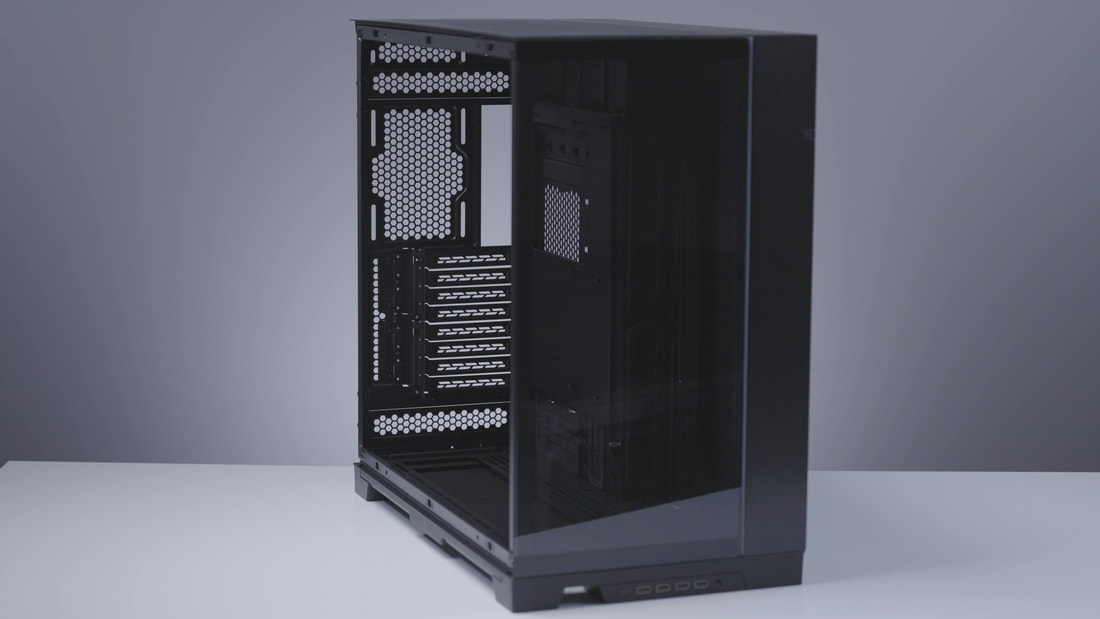
From a construction standpoint, the exterior design of the O11 Dynamic EVO XL features two tempered glass panels, perforated top and side panels for airflow, and a hefty steel construction. All of this is accented by aluminum panels.

The EVO XL carries over a similar button layout to the EVO, including a multidirectional power button, a dedicated Reset button, and two buttons labeled M and C, not because they’re about to drop some sick beats, but because they control the Mode and Color of the ARGB strip that accents the front panel.
Picture
​The exterior I/O has bulked up a bit from the earlier models; we now have four USB 3.0 Type-A ports, as well as a USB Type-C connection and audio jack. Like its ancestors of old, the EVO XL’s front I/O ports are on a module that can be moved from the front of the PC case to the sides, or to the rear of the case.
​
If you want to use all these ports, it will require a motherboard with two internal USB 3.0 headers, or a splitter cable. That may not be an issue for you, but it’s worth considering.

Now that we’ve toured the outside, let’s peek inside.

It’s time to see what Lian Li has done with all that extra space. Let’s start with cooling.
 
Out of the box, the EVO XL does not come with any fans. This means that you’ll need to bring your own to the build. That’s not necessarily a bad thing, because this case has plenty of options to consider for fan orientation... and cables. More on that later.
 
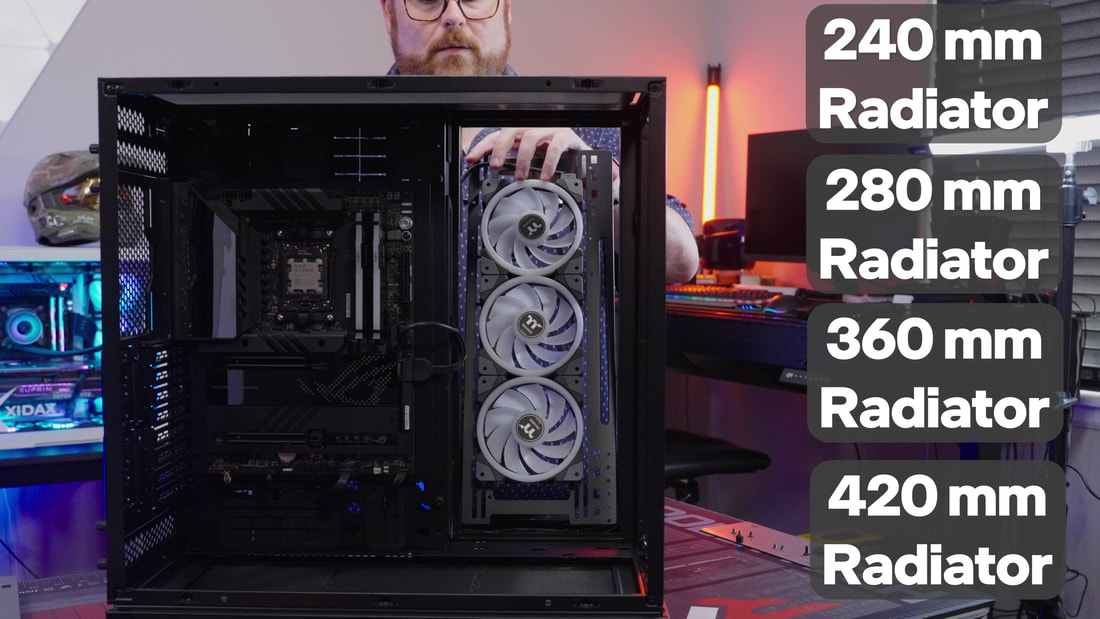
The side, top, and bottom of the case can each accommodate up to three 120 or 140mm fans, or 240, 280, 360, and 420mm radiators in each location. There is also room for up to two 120mm fans in the rear of the case as well, depending on how you orient the motherboard tray. You read that right: the EVO XL has a removable motherboard tray that can be mounted in three different vertical spaces. This flexibility allows builders to play around with where they want to mount their radiator(s) and fans without worrying about whether they have the right clearance to do so.
​ 
Smart!

If you love physical storage, you’re probably going to think that this is smart, too. The EVO XL has seven different locations for hard drives. There are three spots for SSD on the cable management cover, and two hot swappable hard drive bays at the top and bottom of the case, located right behind the motherboard tray. With these two bays, you can fit up to four 3.5-inch hard drives.
 
Now, because of the location of the drive bays, the power supply mount is limited to a center mounting position. Unfortunately, this may be seen as a step backward from previous iterations of the case, because it means no big brain, multi-PSU moves. While most builders aren’t necessarily looking for a case that can accommodate more than one PSU, we noticed the change from the EVO and thought it worthwhile to point out.
 
Since we’re talking about options, let’s talk about GPU mounting options. The EVO XL comes with an anti-sag bracket for GPUs mounted in a more traditional orientation. This is a thoughtful consideration, since this is a case that is built to accommodate the needs of larger components. For builders looking to really showcase their parts, Lian Li has a vertical bracket and PCIe riser kit for $59.99, as well and an upright GPU mounting bracket for $6.99. This upright bracket does require a riser cable, which Lian Li does have as well. It’s 900mm (about 2.95 ft) in length, and it comes in at around $100.
 
With the increased case size, Lian Li says that it can accommodate the chonkiest of GPUs. When we looked at these measurements on paper, it does look like the case could accommodate a hefty GPU like the ROG Strix RTX 4090, even in an upright orientation. But, with the increasing size of GPUs, upright mounting support may be short-lived.
 
Speaking of space, the EVO XL offers a modest amount of space for cable management, which is a bit disappointing to us. This is one area we wished that Lian Li had given us a bit more of that “XL” treatment. To try to solve this problem, Lian Li sticks with the modular theme of this case by giving builders three dual layer cable clips. These clips can be moved around in the back of the case to accommodate the builder’s cable management needs.
 
We really do love to see all of the versatility, but is it enough to handle thick power supply extensions and RGB cables? 
Picture

Building in the O11 Dynamic EVO XL

If you were around for our video review on the O11D EVO, there was a lot that we loved about it. The same is true for the O11 Dynamic EVO XL.
 
The rubber grommets covering the cableways between the front and back of the case made hiding cable runs easy. The freedom to reorient parts is always refreshing, and the fact that it has so many removeable brackets - heck, even openness of the case - it all made building in this thing such a treat. For instance, some people go out for ice cream, but we get to build in the EVO XL… and then go out for ice cream!
 
Because of the increased internal space and the ability to remove brackets, the order of operation for building in the EVO XL is far less important. However, we still found a few things that are worth paying attention to, as well as a few touches that we wish that Lian Li had considered when building this case.
 
We did love that the cable cover in the back is on a hinge, but we wished that it had some type of tie-down mechanism like a screw, a clip, or even a magnet – something to keep it from swinging open when trying to lay the case down.
 
Unfortunately, the hard drive bays have a similar issue. While the included cabling and the placement were both fantastic, the execution just missed the mark for us. Whenever we tried to lay the case down during our builds, those drive bays kept swinging open. Our concern is that these parts will get bent or damaged if builders aren’t careful.

Since we’re talking about being careful, we need to mention the toolless PCI mounting brackets.
 
Here is how it’s supposed to work: each PCI lane has metal posts where there would typically be screw holes. Once you line up the posts with the holes on your card, there is a latching mechanism on the back of the case that secures these components down with pressure, while a thumb screw holds the plate in place. Simple enough, but we ran into a problem.

During one of our testing builds, we got a GPU stuck in the bracket. We had to remove the motherboard itself to get the GPU free from the mechanism. But to their credit, Lian Li contacted us before we brought up this issue, acknowledged that this was a problem, and that they would be sending a replacement motherboard tray to fix it. Not only that, but they also pushed back the launch date to September 7th.
 
At the time of writing this review, we don’t know what Lian Li’s plans are for cases that were already shipped to retailers before this issue was discovered. So, if you do plan on getting one of these on Day One, be sure to take your time building with it. And, like any other build, be especially mindful that you aren’t trying to force parts to fit into place if something starts to feel forced.

Now, let’s talk about thermal performance.
 
We compared the O11 Dynamic EVO XL with a number of similar cases and crowd favorites, including the Hyte Y40, NZXT’s H9 Elite, and Phanteks NV7 - to name a few. We ran a series of tests and benchmarks, recording thermal performance of both the CPU and GPU.
 
To run these tests, we set up the EVO XL with an all-in-one, closed loop water cooler, and we have used the same setup in each of the other cases we’ll be talking about in this breakdown. Sorry to all of you air cooling enthusiasts, no air cooler this time. But stick around, we might have some neat stuff for you soon!
 
Okay, so what about the numbers?
Picture
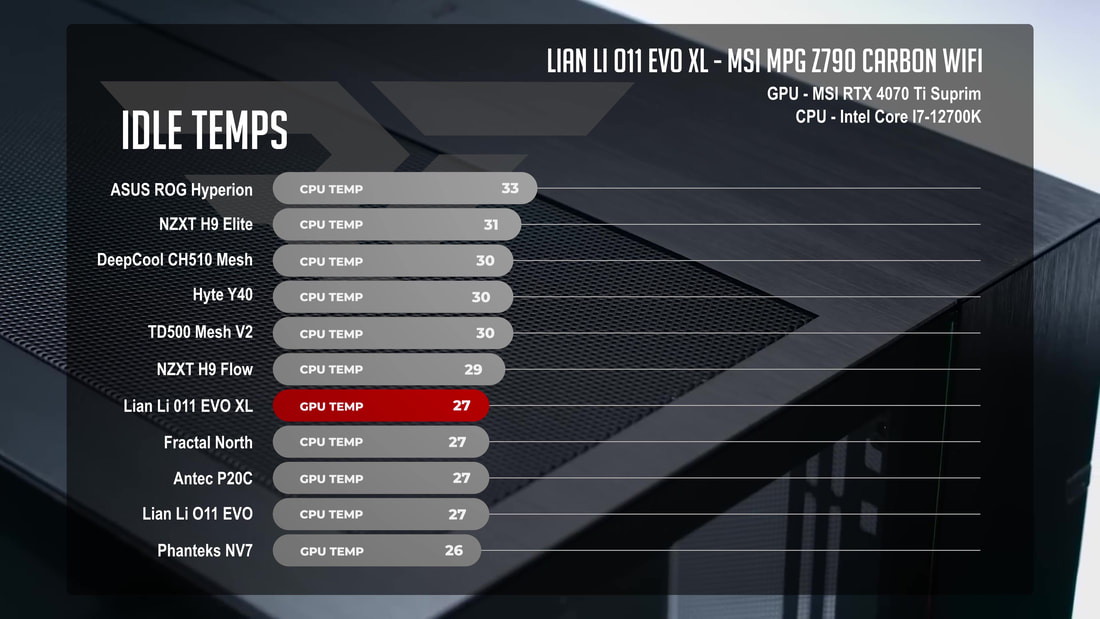
​While idle, CPU temps hovered around 27 degrees Celsius, while GPU temps averaged around 33 C. This put the EVO XL neck-and-neck in idle performance with the Fractal North, while beating more airflow-conscious cases like the H9 Flow from NZXT, and the TD500 Mesh from Cooler Master. While CPU temperatures were similar to the original EVO, the EVO XL ran about 4 degrees warmer.
Picture
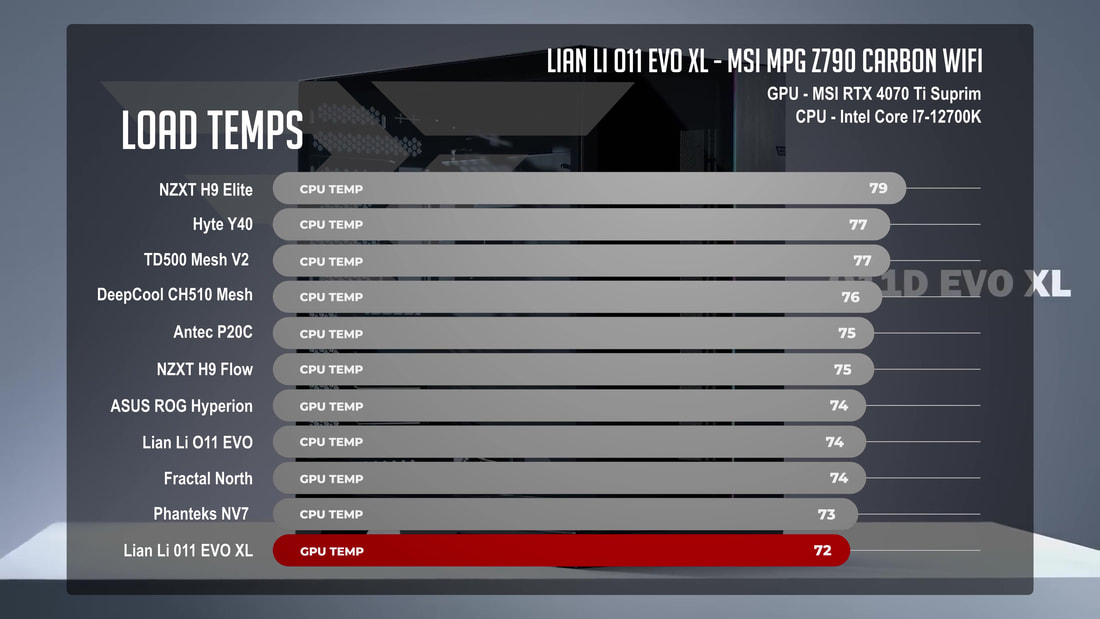
However, once the systems were under heavy CPU load, the EVO XL just crushed it at 72 degrees Celsius, beating the O.G. EVO by two degrees, and the NZXT H9 Elite by seven whole degrees Celsius. I know that probably doesn’t sound much, but it is significant enough to notice!
Picture
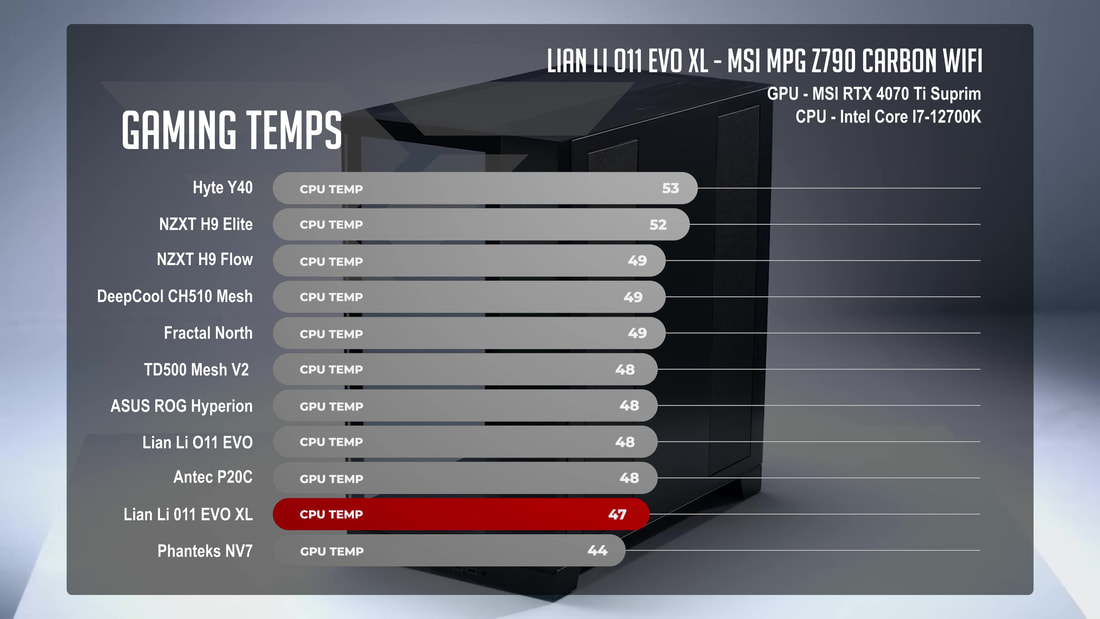
During our 1440p gaming benchmarks, the EVO XL hung out with the cool kids with CPU temps averaging out at 47 degrees Celsius, and GPU temps hovering around 65. The good news is that most of our cases tested well in this benchmark, but there were a few more popular cases that ran a touch hotter than the rest.

So, what’s the bottom line on the EVO XL?

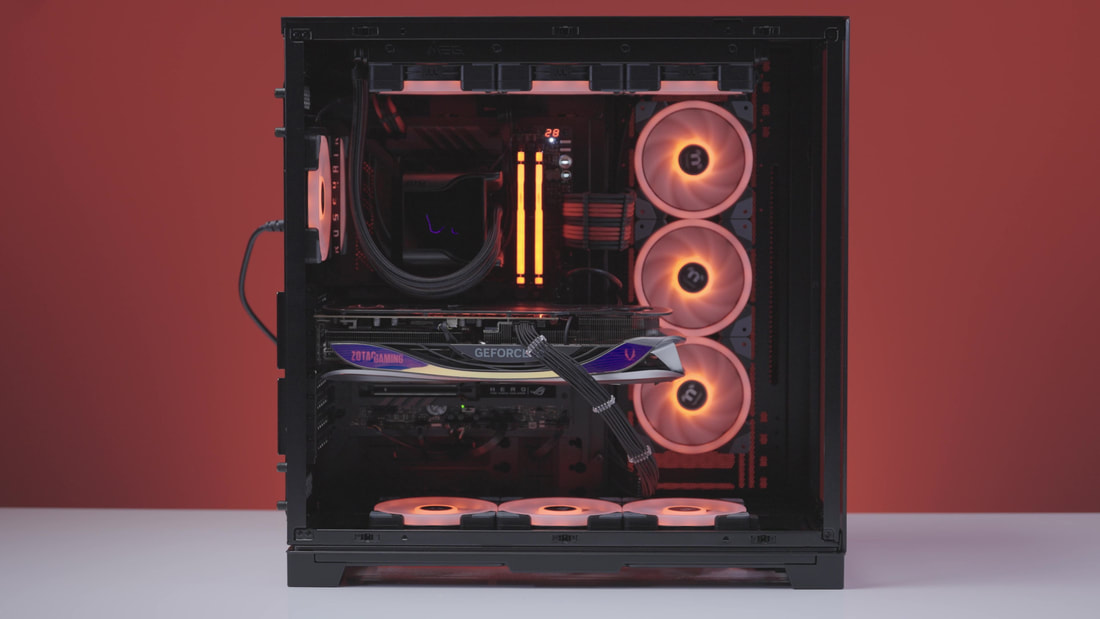
PC cases like the O11 Dynamic EVO XL are just plain beautiful – and there is a good reason why people gravitate toward them. It’s almost effortless to build a beautiful PC in them when you’re working with an already-stunning canvas. And, honestly, there is something so rewarding about stepping back after all the hard work and cable management is done, just to marvel at the majesty of your creation.
 
But I hear you thinking, oh intrepid reader, “It looks good and all, but this IS a review: spill the tea, man!”
 
Okay, we have been doing a lot of gushing about this PC case, because there is a lot to love about it. However, there are some trade-offs.
 
While thermal performance is better than most of its competitors, the EVO XL isn’t set up for thermal success with a tower-style cooler. While the airflow is better than most showcase-style cases, without direct air on the cooler, it’s probably better to stick with an AiO for CPU cooling. It isn’t necessarily a negative, but it is a worthwhile consideration.
 
We mentioned the issues with the toolless mounting in the back, previously. We do hope that Lian Li is about to catch the faulty units before they go on sale, but it’s worth keeping an eye on how Lian Li handles those motherboard tray replacements. Getting replacement parts to influencers and reviewers is one thing, but setting up a comprehensive process for consumers is entirely another.
 
As we mentioned earlier in this review, the EVO XL could have used a touch more space for cable management. When you get a case like this, it’s so wide open that it’s easy to assume that you will have a lot of space to work with.
 
Finally, we would like to have seen better (or any) latching mechanisms for the cable management cover and hard drive bays. Again, we are glad to see these parts on hinges, but they need a way to be secured – especially during the building process!
Picture
So, if you’re not scared off, and you are planning on picking up an EVO XL, we have the following recommendations:

  1. Remove the Hard Drive bays entirely. Unless you desperately need to put a physical hard drive in your system, you are better off having that extra space for cables.
  2. Be smart with the extras. As big as this case is and as many options as it has, you can’t use everything without a trade-off. In other words, the spaces for cable management fill up quickly with every option you choose. It’s easy to get overwhelmed with the sheer number of cables you will inevitably have, especially if you are going to kit this thing out with RGB accessories and cable extensions.
  3. If you’re going to use cable extensions, going with a smaller gauge of wiring will help. If you’re going to fill every possible fan slot, use systems like Corsair’s iCUE LINK, Thermaltake’s SWAFAN series, or Lian Li’s own Uni Fan system to cut down on the sheer volume of cable spaghetti you’ll have to deal with. If you don’t, you’re going to end up water cooling this system with your tears by the time you are finished, and no one wants that. The benchmarks aren’t great on tear-cooled systems.
  4. Oh, and do be careful around the brushed aluminum. It’s pretty, for sure, but it will quickly lose that luster with every touch. These spots are super susceptible to fingers prints!

At the end of the day, the Lian Li O11 Dynamic EVO XL is a pretty impressive case. With E-ATX motherboards and massive GPUs becoming more commonplace, we have to give props to Lian Li for providing a larger version of their beloved case.
 
They took some chances with things like the drive bays and cable covers that we really appreciate seeing, even if they weren’t executed in a way that really spoke to us. While we were a little disappointed that they weren’t as secure as we would like, with a bit more fit and finish, they could be positively amazing features.
 
So, Lian Li, you have our feedback. We look forward to seeing what you do with it, and we’re grateful that you gave us an opportunity to check out the O11 Dynamic EVO XL.
 
These are our impressions, but we want to know what you think. Are you excited to see a bigger version of the O11? Would you build in the EVO XL? Let us know in the comments below and drop some PCPartPicker links if you do decide to build in the O11D EVO XL! We love seeing how creative people are!
 
And to you: If you made it this far, thanks for reading.
0 Comments


Leave a Reply.

    Picture
    Damien
    ​​Storyteller, creative communicator, and people person with a dash of analytical acumen.
    CLICK ME!
© 2024 Robeytech

Home

Builds

resources

deals

Contact

E19823942023LUMIN283